

-
1 Anlauf mit direktem Einschalten
прямой пуск вращающегося электродвигателя
Пуск вращающегося электродвигателя путем непосредственного подключения его к питающей сети.
[ ГОСТ 27471-87]EN
direct-on-line starting
across-the-line starting (US)
the process of starting a motor by connecting it directly to the supply at rated voltage
[IEV number 411-52-15]FR
démarrage direct
mode de démarrage d'un moteur, consistant à lui appliquer directement sa pleine tension assignée
[IEV number 411-52-15]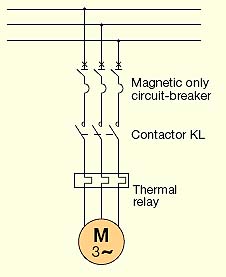
Рис. ABB
Схема прямого пуска электродвигателяMagnetic only circuit-breaker - Автоматический выключатель с электромагнитным расцепителем
Contactor KL - Контактор KL
Thermal relay - Тепловое реле
Параллельные тексты EN-RU
Direct-on-line starting
Direct-on-line starting, which is often abbreviated as DOL, is perhaps the most traditional system and consists in connecting the motor directly to the supply network, thus carrying out starting at full voltage.Direct-on-line starting represents the simplest and the most economical system to start a squirrel-cage asynchronous motor and it is the most used.
As represented in Figure 5, it provides the direct connection to the supply network and therefore starting is carried out at full voltage and with constant frequency, developing a high starting torque with very reduced acceleration times.
The typical applications are relevant to small power motors also with full load starting.
These advantages are linked to some problems such as, for example, the high inrush current, which - in the first instants - can reach values of about 10 to 12 times the rated current, then can decrease to about 6 to 8 times the rated current and can persist to reach the maximum torque speed.The effects of such currents can be identified with the high electro-dynamical stresses on the motor connection cables and could affect also the windings of the motor itself; besides, the high inrush torques can cause violent accelerations which stress the transmission components (belts and joints) generating distribution problems with a reduction in the mechanical life of these elements.
Finally, also the possible electrical problems due to voltage drops on the supply line of the motor or of the connected equipment must be taken into consideration.
[ABB]Прямой пуск
Прямой пуск, который по-английски часто сокращенно обозначают как DOL, является, пожалуй наиболее распространенным способом пуска. Он заключается в непосредственном (т. е. прямом) подключении двигателя к питающей сети. Это означает, что пуск двигателя осуществляется при полном напряжении.Схема прямого пуска является наиболее простым, экономичным и чаще всего применяемым решением для электродвигателей с короткозамкнутым ротором.
Схема прямого подключения к сети представлена на рисунке 5. Пуск осуществляется при полном напряжении и постоянной частоте сети. Электродвигатель развивает высокий пусковой момент при коротком времени разгона.
Типичные области применения – маломощные электродвигатели, в том числе с пуском при полной нагрузке.
Однако, наряду с преимуществами имеются и определенные недостатки, например, бросок пускового тока, достигающий в первоначальный момент 10…12-кратного значения от номинального тока электродвигателя. Затем ток двигателя уменьшается примерно до 6…8-кратного значения номинального тока и будет держаться на этом уровне до тех пор, пока скорость двигателя не достигнет максимального значения.
Такое изменение тока оказывает значительное электродинамическое воздействие на кабель, подключенный к двигателю. Кроме того пусковой ток воздействует на обмотки двигателя. Высокий начальный пусковой момент может привести к значительному ускорению и следовательно к значительной нагрузке элементов привода (ремней, крепления узлов), что вызывает сокращение их срока службы.
И, наконец, следует принять во внимание возможное возникновение проблем, связанных с падением напряжения в линии питания двигателя и подключенного к этой линии оборудования.
[Перевод Интент]
Тематики
Синонимы
EN
- across-the-line starting (US)
- direct line starting
- direct operation of a motor
- direct starting
- direct-on-line starting
- DOL
- full voltage starter application
DE
FR
Немецко-русский словарь нормативно-технической терминологии > Anlauf mit direktem Einschalten
-
2 legen
I v/t1. lay; (bes. stellen, setzen) put; (hinstrecken) lay down; (flach hinlegen) lay flat; eine Tischdecke auf den Tisch legen spread ( oder put) a tablecloth on the table; Eier legen lay eggs; ein Tuch um die Schultern legen wrap a scarf around one’s shoulders; jemandem den Arm um die Schultern legen put one’s arm (a)round s.o.’s shoulders; sich (Dat) die Haare legen lassen have a set (Am. perm oder permanent); den Kopf legen an (+ Akk) rest one’s head against3. (Bombe) plant, (Mine) lay; Feuer legen an (+ Akk) set fire to; einen Brand legen start a fire, commit arson4. Sl., beim Ringen: jemanden legen pin s.o. to the floor; beim Fußball etc.: floor s.o.; beiseite, Hand1, Handwerk 3 etc.II v/refl1. lie down; sich schlafen oder ins Bett legen go to bed; sich auf etw. (+ Akk) legen Mensch, Tier: lie on s.th.; Staub, Nebel etc.: settle on s.th.; sich aufs Gemüt legen fig. get one down, be depressing2. fig. (nachlassen) Sturm, Wind, Lärm, auch Begeisterung, Aufregung etc.: die down; Skandal, Streit etc.: blow over; Spannung: ease off; Schmerz: ease; völlig: go awayIII v/i Huhn etc.: lay (eggs)* * *das Legensiting* * *le|gen ['leːgn]1. vt1) (= lagern) to lay down; (mit adv) to lay; Flasche etc to lay on its side; (= zusammenlegen) Wäsche to fold; (dial) Kartoffeln etc to plant, to put in; (SPORT) to bring down2) (mit Raumangabe) to put, to placewir müssen uns ein paar Flaschen Wein in den Keller légen — we must lay down a few bottles of wine
etw in Essig etc légen — to preserve sth in vinegar etc
3)er legte die Stirn in Falten — he frowned, he creased his brow
eine Stadt in Schutt und Asche légen — to reduce a town to rubble
Feuer or einen Brand légen — to start a fire
die Haare légen lassen — to have one's hair set
Dauerwellen etc légen lassen — to have a perm etc, to have one's hair permed etc
5) (Huhn) Eier to lay2. vi(Huhn) to lay3. vr1) (= hinlegen) to lie down (auf +acc on)sich in die Sonne légen —
See:→ schlafen2) (mit Ortsangabe)(=niederlegen Nebel, Rauch) to settle (auf +acc on)sich auf die Seite légen — to lie on one's side; (Boot) to heel over, to go over onto its side
sich in die Kurve légen —
sich auf ein Spezialgebiet légen — to concentrate on or specialize in a particular field
3) (= abnehmen) (Lärm) to die down, to abate; (Sturm, Wind auch, Kälte) to let up; (Rauch, Nebel) to clear; (Zorn, Begeisterung auch, Arroganz, Nervosität) to wear off; (Anfangsschwierigkeiten) to sort themselves outdas Fieber legt sich bald — his/her etc temperature will come down soon
* * *1) set2) (to place, set or put (down), often carefully: She laid the clothes in a drawer / on a chair; He laid down his pencil; She laid her report before the committee.) lay3) (to place in a lying position: She laid the baby on his back.) lay4) ((of a bird) to produce (eggs): The hen laid four eggs; My hens are laying well.) lay5) (to put, cut or arrange in layers: She had her hair layered by the hairdresser.) lay6) (the process of setting hair: a shampoo and set.) set* * *le·gen[ˈle:gn̩]I. vt1. (waagerecht stellen)▪ etw \legen to put [or place] sth on its side2. (liegen lassen)▪ jdn \legen to put sb in a lying position; Ringer to throw sb; SPORT (sl: foulen) to bring down sb sepman legte sie zu ihrem Mann ins Grab she was laid to rest beside her husbandjdn auf den Rücken \legen to put [or place] sb on their back3. (anlehnen)4. (hintun)▪ etw irgendwohin \legen to put sth somewhereer legte den Kopf an ihre Schulter he leaned his head on her shoulderdie Betonung auf ein Wort \legen to stress a wordjdm eine Binde/die Hände vor die Augen \legen to blindfold sb/to put one's hands over sb's eyessie legt viel Gefühl in ihr Geigenspiel she plays violin with great feelingdie Hand an den Hut/die Stirn \legen (begrüßen) to touch one's hat/foreheadetw aus der Hand \legen to put down sth sepden Riegel vor die Tür \legen to bolt the door▪ jdn irgendwohin \legen:sie legte ihren Sohn an die Brust she breastfed her son5. (bringen)▪ jdn/etw irgendwohin \legen to bring/take sb/sth somewhere; Patient to move [or transfer] sb somewhere; s.a. Kante6. (verlegen)7. (befestigen)den Hund an die Kette \legen to put the dog on the chain8. ORNein Ei \legen Vogel to lay an eggetw \legen to plant sth10. (konservieren)11. (falten)▪ etw \legen to fold sthetw in Falten \legen to fold sthdas Gesicht/die Stirn in Falten \legen to frownII. vr1. (liegen)leg dich! (an Hund) lie!2. (lehnen)der Radfahrer legte sich in die Kurve the cyclist leaned into the bendsie legte sich mit den Ellbogen auf den Tisch she leaned her elbows on the tablesich akk auf die Seite \legen to lean to one [or the] side; Schiff a. to list; (kentern) to capsize, to keel over; Flugzeug to bank3. (decken)▪ sich akk auf [o über] etw akk \legen Nebel to descend [or settle] on sth; Schnee to blanket sth; Licht to flood sthdichter Bodennebel legte sich auf die Straße thick fog formed in the street4. (schaden)6. (nachlassen)▪ sich akk \legen Aufregung to die down, to subside; Begeisterung to subside, to wear off, to fade; Lärm to abate, to die down; Nebel to lift; Schmerzen to disappear, to wear off; Wind, Regen to subside, to abate, to die down; Wut to abate, to subsideihre Trauer wird sich \legen they'll get over their griefes wird sich [bald wieder] \legen it'll [soon] pass7. (widmen)III. vi to layIV. vb aux* * *1.transitives Verb1) lay [down]jemanden auf den Rücken legen — lay somebody on his/her back
etwas aus der Hand/beiseite legen — put something down/aside or down
2) (verlegen) lay <pipe, cable, railway track, carpet, tiles, etc.>3) (in eine bestimmte Form bringen)sich (Dat.) die Haare legen lassen — have one's hair set; s. auch Falte 3)
4) (schräg hinstellen) lean2.etwas an etwas (Akk.) legen — lean something [up] against something
transitives, intransitives Verb < hen> lay3.reflexives Verb1) lie downsich auf etwas (Akk.) legen — lie down on something
das Schiff/Flugzeug legte sich auf die Seite — the ship keeled over/the aircraft banked steeply
sich in die Kurve legen — lean into the bend; s. auch Bett 1); Ohr 2)
2) (nachlassen) < wind, storm> die down, abate, subside; < noise> die down, abate; < enthusiasm> wear off, subside, fade; < anger> abate, subside; < excitement> die down, subside3) (sich herabsenken)sich auf od. über etwas (Akk.) legen — < mist, fog> descend or settle on something, [come down and] blanket something
* * *A. v/teine Tischdecke auf den Tisch legen spread ( oder put) a tablecloth on the table;Eier legen lay eggs;ein Tuch um die Schultern legen wrap a scarf around one’s shoulders;jemandem den Arm um die Schultern legen put one’s arm (a)round sb’s shoulders;sich (dat)den Kopf legen an (+akk) rest one’s head againstFeuer legen an (+akk) set fire to;einen Brand legen start a fire, commit arsonB. v/r1. lie down;ins Bett legen go to bed;sich auf etwas (+akk)sich aufs Gemüt legen fig get one down, be depressing2. fig (nachlassen) Sturm, Wind, Lärm, auch Begeisterung, Aufregung etc: die down; Skandal, Streit etc: blow over; Spannung: ease off; Schmerz: ease; völlig: go away3. fig:C. v/i Huhn etc: lay (eggs)* * *1.transitives Verb1) lay [down]jemanden auf den Rücken legen — lay somebody on his/her back
etwas aus der Hand/beiseite legen — put something down/aside or down
2) (verlegen) lay <pipe, cable, railway track, carpet, tiles, etc.>4) (schräg hinstellen) lean2.etwas an etwas (Akk.) legen — lean something [up] against something
transitives, intransitives Verb < hen> lay3.reflexives Verb1) lie downsich auf etwas (Akk.) legen — lie down on something
das Schiff/Flugzeug legte sich auf die Seite — the ship keeled over/the aircraft banked steeply
sich in die Kurve legen — lean into the bend; s. auch Bett 1); Ohr 2)
2) (nachlassen) <wind, storm> die down, abate, subside; < noise> die down, abate; < enthusiasm> wear off, subside, fade; < anger> abate, subside; < excitement> die down, subsidesich auf od. über etwas (Akk.) legen — <mist, fog> descend or settle on something, [come down and] blanket something
* * *placement n.
См. также в других словарях:
affect — affect, effect 1. These two words are often confused. It should be remembered that effect is most common as a noun meaning ‘a result or consequence’ • (In England, at any rate, education produces no effect whatsoever Oscar Wilde) and that affect… … Modern English usage
affect, effect — These words have slightly different pronunciations and quite different meanings. Affect is always a verb (except for one use as a noun in psychology) and means to influence, to cause a response : This article will affect my thinking. Affect also… … Dictionary of problem words and expressions
Affect consciousness — refers to the mutual relationship between activation of basic affective experiences and the individual’s capacity to consciously perceive, tolerate, reflect upon and express these experiences (Monsen Monsen, 1999). AC is traditionally… … Wikipedia
affect vs effect — Affect and effect are two words that are commonly confused. affect is usually a verb (action) effect is usually a noun (thing) Hint: If it s something you re going to do, use affect. If it s something you ve already done, use effect. To… … English dictionary of common mistakes and confusing words
affect vs effect — Affect and effect are two words that are commonly confused. affect is usually a verb (action) effect is usually a noun (thing) Hint: If it s something you re going to do, use affect. If it s something you ve already done, use effect. To… … English dictionary of common mistakes and confusing words
Affect (philosophy) — Affect (latin affectus or adfectus) is a concept used in philosophy by Spinoza, Deleuze and Guattari. According to Spinoza s Ethics III, 3, Definition 3, an affect is an empowerment, and not a simple change or modification. Affects, according to… … Wikipedia
affect — affect1 [ə fekt′; ] for n. [ 2, af′ekt΄] vt. [ME affecten < L affectare, to strive after < affectus, pp. of afficere, to influence, attack < ad , to + facere, DO1] 1. to have an effect on; influence; produce a change in [bright light… … English World dictionary
affect — affect, affective, affectivity An affect is an emotion. In sociology the use of the term generally implies that an action is being or has been carried out for emotional gratification. For example, in their discussion of Class Awareness in the… … Dictionary of sociology
Affect (psychology) — Affective redirects here. For other uses, see Affect (disambiguation). Affect refers to the experience of feeling or emotion.[1] Affect is a key part of the process of an organism s interaction with stimuli. The word also refers sometimes to… … Wikipedia
Affect display — In psychology, affect display or affective display is a subject s externally displayed affect. The display can be by facial, vocal, or gestural means (APA 2006, p. 26). When displayed affect is different from the subjective affect, it is… … Wikipedia
Affect theory — In psychology, affect is an emotion or subjectively experienced feeling. Affect theory is a branch of psychoanalysis that attempts to organize affects into discrete categories and connect each one with its typical response. So, for example, the… … Wikipedia
